
F‑35 in 2026: Milestones, Money, and the March to Block 4
F‑35 in 2026: Germany’s first jet rolls out, engine upgrade clears review, but GAO flags readiness—what’s new, what it costs, and what to watch next.
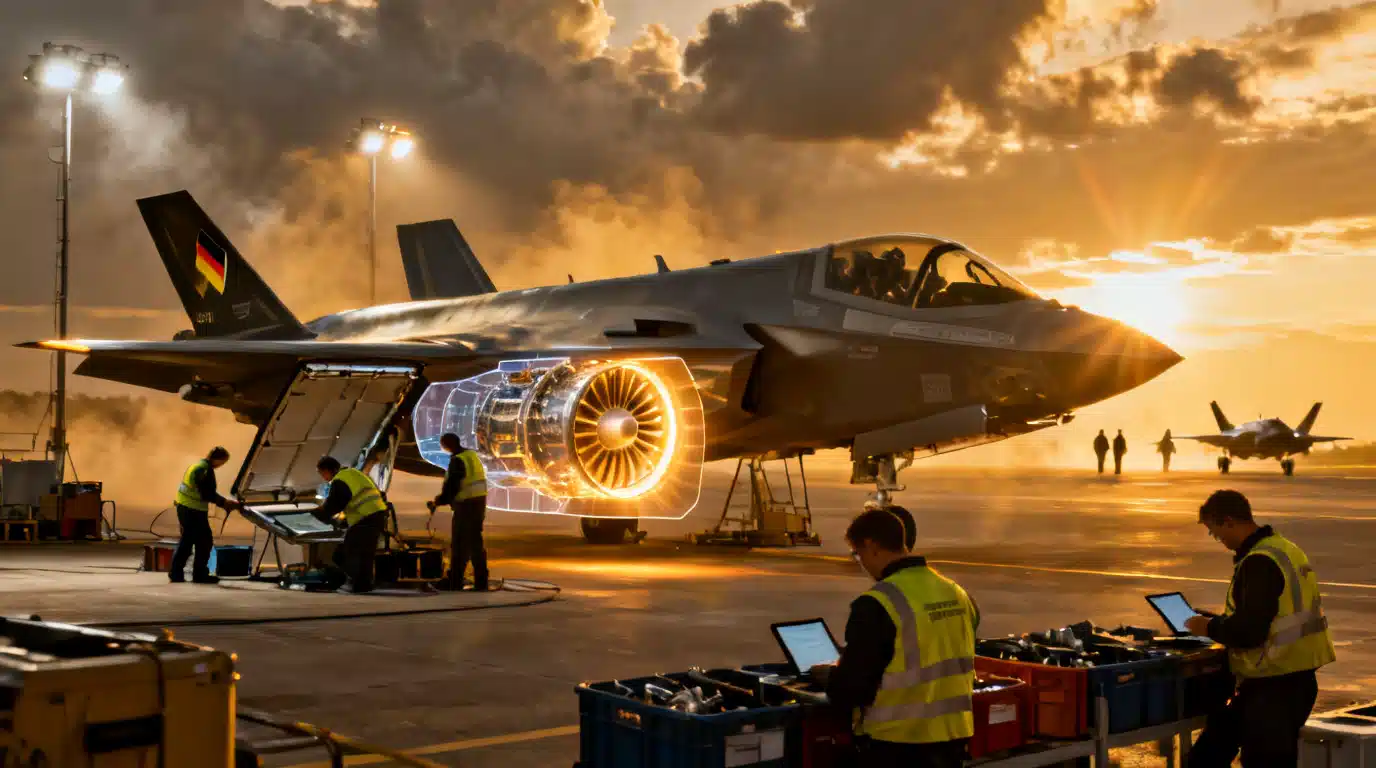
Image used for representation purposes only.
F‑35 in 2026: New milestones, hard lessons, and what’s next
A year of sharp contrasts has pushed the F‑35 program into the headlines again. In September 2026, Germany rolled out its first F‑35A, underscoring how rapidly the fighter’s user base is expanding across NATO. Days earlier, Pratt & Whitney said the F135 Engine Core Upgrade cleared a key design review, a step toward the extra power and cooling Block 4 will need. Yet watchdogs still flag declining readiness, with just one in four U.S. F‑35s fully mission capable in fiscal 2025, prompting the Pentagon to seek billions more for sustainment. (investors.lockheedmartin.com )
What’s new now
- Germany’s first F‑35A rolled out on September 18, 2026, marking a watershed for Berlin’s nuclear‑sharing and deep‑strike plans and highlighting NATO’s accelerating F‑35 adoption. The Luftwaffe formally accepted the jet at Lockheed’s Fort Worth facility. (investors.lockheedmartin.com )
- Pratt & Whitney completed the F135 Engine Core Upgrade Risk Reduction Design Review on September 15, 2026—positioning the engine refresh for production decisions that underpin Block 4’s higher thermal and electrical loads. (rtx.com )
- The U.S. Government Accountability Office’s June 2026 sustainment audit reported the F‑35 fleet’s full mission capable (FMC) rate fell to about 25% in FY25, while mission capable (MC) rates slid to roughly 44%, driving a proposed $13.7 billion readiness push. (gao.gov )
- After a turbulent 2024, deliveries rebounded: Lockheed Martin says it delivered a record 191 jets in 2025 and fielded the most advanced TR‑3 software to date, expanding a global fleet now approaching 1,300 aircraft. (investors.lockheedmartin.com )
Modernization status: TR‑3, Block 4 and power/thermal upgrades
Technology Refresh 3 (TR‑3) is the avionics backbone for Block 4—new processors, memory and display electronics that dramatically raise computing, throughput and storage. L3Harris supplies the Integrated Core Processor, Aircraft Memory System and Panoramic Cockpit Display electronic unit; GAO now assesses the ICP as “mature,” removing a major hardware bottleneck that contributed to 2024’s delivery pauses. (engage.l3harris.com )
Even so, TR‑3’s software train has been a pacing item. The Joint Program Office provisionally accepted early TR‑3 aircraft in 2024 with limited combat capability to avoid parking large numbers of completed jets at factories; those airframes are being upgraded in the field as software stabilizes. DOT&E similarly documented acceptance of “truncated” TR‑3 builds in 2025, a pragmatic—but disruptive—workaround to keep production flowing. (gao.gov )
Underneath Block 4, the Pentagon is also running a two‑year analysis of upgrades to the F‑35’s Power and Thermal Management Unit (PTMU), a key enabler for future sensors and weapons. Lockheed Martin is due to present options when that study wraps in December 2026, shaping which systems get upgraded and when. (files.gao.gov )
Combat performance vs. fleet readiness
Officials say 2026 combat deployments to the Middle East—particularly Operation Epic Fury—showed the F‑35 could sustain high sortie rates when parts, maintenance and command attention surged. Air Combat Command leaders credited improved spares flows for the jet’s strong showing. But GAO and service data still point to structural sustainment problems that depress day‑to‑day availability across the broader fleet. (airandspaceforces.com )
The Pentagon and Congress have begun moving money and authorities to arrest the slide. Reports in June highlighted a $13.7 billion readiness package across the services, while the Joint Program Office agreed with GAO recommendations to tighten incentives and financial controls in sustainment contracts. Near‑term goals are to stabilize MC rates, with longer‑range targets aiming for substantially higher FMC rates by the end of the decade. (stripes.com )
Weapons integration: JSM fielding gathers pace; UK’s SPEAR 3 advances; Meteor timeline
- Joint Strike Missile (JSM): The USAF awarded Lot 2 production in June 2026 as Kongsberg’s stealthy, internally carried cruise missile gains traction across the F‑35A community. Japan received its first JSM deliveries in Q1 2026; Germany followed with additional orders in May; and Canada became the sixth nation to select the weapon in July. (thedefensepost.com )
- UK SPEAR 3: The UK’s miniature, networked standoff weapon entered low‑rate production in 2026 and achieved first F‑35B flight‑carriage tests this spring, with MBDA and program offices working toward full integration later in the decade. (mbda-systems.com )
- Meteor: London updated Parliament in April 2026 on efforts with the F‑35 Joint Program Office to integrate the ramjet AAM on UK F‑35Bs, an enduring priority alongside SPEAR 3. (questions-statements.parliament.uk )
Global expansion: Who’s joining and when
- Canada: Ottawa’s program timeline places the first eight F‑35As at Luke AFB, Arizona, beginning in late 2026 for pilot training, with the first aircraft arriving in Canada in 2028 once Cold Lake infrastructure is ready. (canada.ca )
- Germany: First F‑35A presented to the Luftwaffe on September 18, 2026; the rollout advances Germany’s nuclear‑sharing recapitalization and deepens NATO interoperability. (investors.lockheedmartin.com )
- Greece: Washington transmitted the Letter of Offer and Acceptance in April 2024; Athens countersigned in July 2024 for an initial 20 F‑35As. (mod.mil.gr )
- Romania: Bucharest signed an LOA in November 2024 for 32 F‑35As in two phases, with deliveries planned in the early 2030s. (mapn.ro )
- Czech Republic: Prague’s 24‑jet buy was sealed in early 2024; first deliveries to the Czech Republic begin in 2031. (mo.gov.cz )
Meanwhile, NATO’s annual nuclear‑deterrence exercise Steadfast Noon begins October 13, 2026, as more allied F‑35As become “dual‑capable” for the B61‑12 and the UK signals plans to rejoin the Alliance’s DCA mission with additional F‑35 procurement. (nato.int )
Production and cost picture
The Lot 18–19 airframe contract finalized in September 2025 covers 296 fighters worth $24.29 billion; officials said per‑jet airframe price growth was kept below inflation. Separate engine awards put the Lot 18 F135 at roughly $20.4 million apiece, placing average fully equipped aircraft near the $100 million mark across variants. Negotiators and auditors continue to caution that inflation, supply chain pressures and content growth (TR‑3/Block 4) are upward cost drivers. (airandspaceforces.com )
Outlook: The five storylines to watch through 2027
- ECU toward production: With RRDR complete, attention turns to final design milestones and ramp planning for fleet retrofits that unlock sustained Block 4 performance margins. (rtx.com )
- Power/thermal decisions: The PTMU study due in December 2026 will set the scope and sequencing for cooling and power upgrades—pivotal for next‑gen sensors and weapons. (files.gao.gov )
- Software cadence: How quickly the TR‑3 software train can stabilize across all users—and clear residual “truncated” builds—will determine when stored capability becomes fielded combat power. (dote.osd.mil )
- Readiness recovery: The services’ ability to translate 2026’s surge lessons into sustained, fleet‑wide availability—backed by the $13.7 billion infusion—will be the defining metric for critics and supporters alike. (breakingdefense.com )
- NATO nuclear posture: As more allies receive their first jets and infrastructure comes online, expect more F‑35 participation in Steadfast Noon and related nuclear‑sharing readiness activities. (nato.int )
Bottom line: 2026 showed that the F‑35 can surge when it must, that modernization is advancing—if unevenly—and that allied adoption keeps widening. The program’s credibility, however, now hinges on converting money and milestones into everyday readiness and Block 4 capability in the field. (airandspaceforces.com )
Related Posts

Taiwan’s March Crunch: Defense Deadlines, PLA Drills, and an AI-Powered Economy
As March deadlines loom for U.S. arms deals, Taiwan weighs defense budgets and PLA pressure against an AI-driven economic surge and a new U.S. trade pact.

Palantir’s 2026 pivot: record Q4, Miami HQ move, and billion‑dollar government bets
Palantir starts 2026 with a record Q4, a Miami HQ move, and major U.S./U.K./NATO contracts—testing how fast its AIP flywheel can turn at scale.